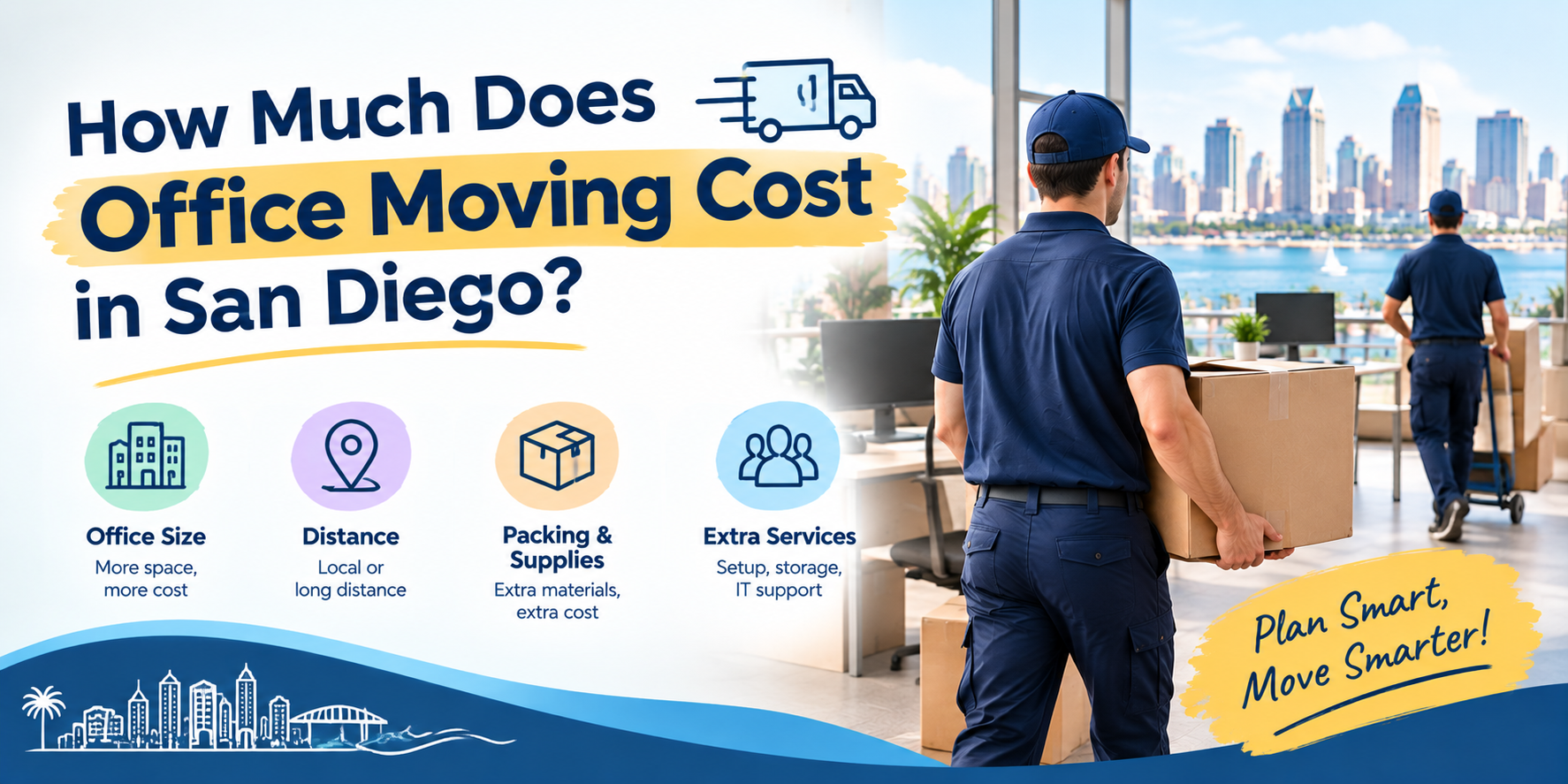
Planning an office relocation requires more than choosing a new workspace and arranging transportation. Businesses also need to budget for moving labor, packing materials, furniture handling, equipment transportation, and the time required to get employees working in the new location. Understanding the potential costs in advance can help you plan your move without putting unnecessary pressure on your business budget.
The cost of office moving in San Diego depends on several factors, including the size of your office, the number of workstations, the distance between locations, building access, and the level of service you need. A small office with a few desks and computers may require a relatively straightforward move, while a larger workspace with conference rooms, filing cabinets, specialized equipment, and multiple departments may need a more detailed relocation plan.
Whether you are moving a startup, a professional office, or an established business, comparing moving estimates and understanding the services included can help you make a more informed decision. This guide explains the main factors that affect office moving costs in San Diego and how to prepare a realistic relocation budget.
How Much Does Office Moving Cost in San Diego?
There is no single price that applies to every office move. Commercial moving companies typically assess the amount of furniture and equipment, the number of movers required, the transportation distance, and the work involved before providing an estimate.
As a general budgeting reference, some published 2026 San Diego moving guides place smaller office relocations around $1,200 to $3,000, medium-sized office moves around $3,000 to $6,500, and larger projects at $6,500 or more. These are broad estimates from third-party sources, not verified prices from US Eagle Moving, and actual quotes may fall outside these ranges depending on the scope of work.
The following table illustrates how the size and complexity of a move can affect your budget.
| Type of Office Move | Typical Cost Considerations |
|---|---|
| Small office | A limited number of desks, chairs, computers, and boxes |
| Medium-sized office | Multiple workstations, filing cabinets, conference furniture, and more labor |
| Large office | Several departments, extensive inventory, multiple trucks, or a phased schedule |
| Specialized commercial move | Servers, sensitive equipment, unusually heavy items, or complex furniture systems |
These categories are intended for initial planning rather than as fixed price quotes. The most accurate way to determine your office moving cost in San Diego is to request an estimate based on your actual inventory, moving addresses, building conditions, and service requirements.
1. Office Size and Number of Workstations
Office size is one of the first factors moving companies consider when estimating relocation costs. A larger office generally contains more items to pack, protect, load, transport, and place at the destination.
However, square footage alone does not determine the final price. A compact office with heavy filing cabinets, extensive storage, and specialized equipment may take more work to move than a larger workspace with fewer belongings.
When requesting an estimate, provide details about the number of desks, chairs, workstations, conference tables, storage units, and other furniture items. An inventory or photographs of the current workspace can help the moving company understand the scope of the job.
Providing accurate information from the beginning makes it easier to compare quotes and reduces the chance of unexpected changes on moving day.
2. Distance Between the Two Office Locations
The distance between your current office and your new location can influence transportation time, fuel expenses, and the overall schedule. A move within the same San Diego business district may involve different costs from a relocation across the county or to another city.
However, distance is only part of the calculation. Traffic conditions, loading arrangements, parking availability, and access to each building can also affect how long the move takes.
For example, relocating between two ground-floor offices with convenient loading areas may be simpler than moving between upper-floor suites that require freight elevators and advance building reservations.
When asking for an estimate, provide both complete addresses and explain any access restrictions. This allows the moving company to assess the route and logistical requirements more accurately.
3. Labor and Number of Movers Required
Labor is another important component of commercial moving costs. The number of movers required depends on the amount of inventory, the size and weight of the items, the layout of the buildings, and your preferred moving schedule.
A small office may need a smaller crew, while a large office relocation may require additional workers to handle furniture, pack equipment, and coordinate multiple areas of the workspace.
The duration of the move also matters. If access is difficult or items require extensive disassembly, the crew may need more time to complete the job.
Ask whether the estimate is based on hourly labor, a fixed project price, or another pricing arrangement. If hourly pricing applies, confirm the minimum booking period, the number of movers included, and how additional time is billed.
Understanding these details can help you compare office moving estimates more fairly.
4. Packing Materials and Professional Packing Services
Packing requirements can significantly affect your office relocation budget. Some businesses prefer to pack documents and personal desk items themselves, while others need professional assistance with furniture, electronics, and fragile equipment.
Common packing requirements include sturdy boxes, protective wrapping, labels, cushioning materials, and specialized packaging for delicate items. The quantity and type of supplies depend on what needs to be moved.
Professional packing can be especially useful when a business has many workstations, shared equipment, glass furniture, or a limited amount of time to prepare.
To manage costs, decide which items your employees can safely pack and which require professional handling. Ask the moving company to list packing labor and materials separately in the estimate when possible.
This makes it easier to adjust the service level to your budget without overlooking important protection requirements.
5. Furniture Disassembly and Reassembly
Many commercial offices contain modular desks, cubicles, conference tables, shelving systems, reception counters, and large storage cabinets. Some of these items must be disassembled to fit through doorways, corridors, elevators, or loading areas.
Disassembly and reassembly can require additional labor and time, particularly when furniture systems are complex or contain numerous components.
Before moving day, identify which items need to be taken apart and whether they must be reassembled at the destination. Ask the movers to confirm whether these tasks are included in the quoted price.
It is also helpful to label furniture components and keep associated hardware organized. For complex workstation arrangements, photographs of the original setup can make reassembly easier.
Planning these details ahead of time helps prevent delays and allows you to budget for the actual work involved.
6. IT Equipment and Electronics
Computers, monitors, printers, networking equipment, and server hardware are often among the most important assets in an office. Their transportation requires careful coordination because damage or delays can affect business operations.
The cost of moving IT equipment depends on the amount of hardware, the packing requirements, and whether separate technical services are needed.
Your internal IT team or qualified provider should plan data backups, system shutdowns, cable labeling, and reconnection. Do not assume that standard moving labor includes disconnecting, configuring, or testing business technology.
If your office contains servers, network racks, specialized machinery, or other sensitive equipment, identify those items before requesting a quote.
A clear division of responsibilities between the moving company and your IT team can help prevent confusion and reduce the risk of costly operational delays.
7. Building Access, Elevators, and Parking
Building access can influence office moving costs even when the two locations are relatively close together.
Some commercial buildings require advance reservations for freight elevators, loading docks, or designated moving periods. Others may have limited parking, restricted vehicle access, security procedures, or long distances between the office suite and the loading area.
These conditions can increase the time needed to load and unload furniture and equipment. In certain situations, additional handling or transportation arrangements may also be necessary.
Before moving day, contact the property managers at both locations to confirm their requirements. Ask whether a certificate of insurance is needed, whether the elevator must be reserved, and where the moving truck can park.
Share these details with your moving company before accepting an estimate. This helps the company plan the move around actual building conditions rather than making assumptions.
8. Weekend and After-Hours Moving
Businesses often prefer to relocate during evenings or weekends to reduce disruption to employees and customers. Moving outside normal business hours may be a practical choice, but the pricing depends on the company’s availability, staffing, and scheduling policies.
An after-hours move can also involve tighter deadlines. For example, a business may need furniture and essential equipment transported and placed before employees return to work on Monday.
When comparing quotes, ask whether evening, weekend, or holiday scheduling changes the price. Confirm the expected start time, completion window, and process for handling delays.
It is also important to consider the cost of business downtime. A slightly different moving schedule may be worthwhile if it helps protect customer service, employee productivity, and essential operations.
9. Temporary Storage and Additional Services
Sometimes a business cannot move directly from its old office into the new one. Lease dates, renovations, construction delays, or access problems may create a gap between the two locations.
In these situations, temporary storage may be necessary. Storage costs depend on the amount of space required, the length of time items remain stored, access needs, and any additional handling involved.
Other potential expenses include moving items between multiple locations, removing unwanted furniture, handling oversized equipment, or arranging specialized packing.
Discuss these requirements before the move rather than adding them unexpectedly at the last minute. If your business needs storage, ask about the available options, terms, and charges.
Planning for these services early helps you build a more complete budget and reduces the likelihood of last-minute logistical problems.
10. Insurance and Protection for Office Assets
Office furniture and equipment can represent a substantial investment. Before hiring movers, understand what protection is available for items during transportation and handling.
Ask the moving company to explain its liability arrangements, valuation options, exclusions, and claims procedures. The protection available may vary depending on the type of move and the terms of the agreement.
If your business has high-value computers, specialized equipment, confidential records, or expensive furniture, document those items before the relocation. Keep relevant inventory records and photographs where appropriate.
Do not assume that standard moving coverage automatically provides full replacement value for every item. Review the terms carefully and ask questions before signing the agreement.
Understanding your options helps you make informed decisions about protecting business property and budgeting for the move.
11. How to Reduce Office Moving Costs in San Diego
Reducing relocation expenses does not necessarily mean choosing the cheapest moving company. A more effective approach is to organize the move, reduce unnecessary work, and make sure the estimate reflects your actual needs.
Create an Accurate Inventory
Prepare a list of furniture, equipment, boxes, and other items that need to be moved. Identify anything that will remain at the current office or be disposed of before relocation.
A clear inventory helps movers estimate the required labor and transportation more accurately.
Remove Unnecessary Office Items
Moving unwanted furniture, outdated equipment, and unused supplies adds to the workload. Review your inventory before packing and arrange appropriate disposal or recycling for items your business no longer needs.
Pack Nonessential Items in Advance
If your employees can safely pack personal desk items, nonconfidential supplies, and ordinary documents, doing so may reduce the amount of professional packing labor required.
Keep specialized equipment and fragile items separate for assessment by the appropriate team.
Compare Detailed Written Estimates
Request estimates from more than one qualified moving company. Provide each company with the same inventory, addresses, schedule, and service requirements.
Compare what each quote includes rather than choosing based only on the lowest total. Pay attention to additional labor, packing materials, furniture assembly, storage, and scheduling fees.
Plan the Schedule Early
Early planning gives your business more time to coordinate with building management, prepare employees, and confirm moving company availability.
It also helps identify access restrictions and technical requirements before they become urgent problems.
12. How to Budget for an Office Move
A practical office moving budget should include more than the transportation estimate. Businesses should account for the full relocation process, including preparation, packing, setup, and any operational adjustments.
Use this checklist when preparing your budget:
- Moving company labor and transportation
- Packing materials and professional packing services
- Furniture disassembly and reassembly
- IT equipment preparation and technical support
- Building access arrangements and applicable fees
- Temporary storage, if required
- Specialized handling for oversized or fragile items
- Unpacking and workspace setup
- Contingency funds for changes in the moving scope
Keep the moving estimate and other relocation expenses in separate categories. This makes it easier to see which costs are included in the mover’s quote and which must be arranged independently.
Once you receive a written estimate, review it with the person responsible for your company’s budget. Confirm the payment schedule, cancellation terms, and process for approving additional work.
A clear budget gives you a better understanding of the total financial commitment before moving day arrives.
Why Choose US Eagle Moving for Office Moving in San Diego?
Planning a commercial relocation is easier when you can discuss your requirements with a moving company that offers office moving services.
US Eagle Moving provides office moving services in San Diego for businesses planning to relocate their workspace. The appropriate moving arrangements depend on the size of your office, the inventory involved, the destination, and the services you need.
When contacting the company, explain how many workstations you have, whether furniture needs disassembly, what equipment requires special attention, and whether you need packing or storage. Also share your preferred moving date and any building access restrictions.
These details can help the team assess your requirements and provide information about the services and estimate available for your move.
To discuss your relocation, visit US Eagle Moving.
Conclusion
Office moving costs in San Diego depend on the amount of furniture and equipment being relocated, the distance between locations, labor requirements, packing services, building access, and the moving schedule. Understanding these factors can help you prepare a realistic budget and avoid overlooking important expenses.
Before choosing a moving company, create an inventory, compare detailed written estimates, and confirm which services are included. Make sure you also plan for IT equipment, building requirements, and the time your team needs to resume normal operations.
If your business is preparing for an office relocation, contact US Eagle Moving to discuss your moving requirements and request an estimate. Call (858) 752-5051 to get started.
Frequently Asked Questions
How much does it cost to move a small office in San Diego?
The cost depends on the number of workstations, the volume of furniture and equipment, the distance between locations, and the services required. Some published 2026 guides estimate small office moves at approximately $1,200 to $3,000, but this is only a general planning range and not a guaranteed price. Request a quote based on your specific office.
What is the biggest factor affecting office moving costs?
Office size and inventory are important factors, but labor, building access, packing requirements, IT equipment, and scheduling can also affect the final price. A detailed assessment provides a better estimate than office square footage alone.
Do office movers charge by the hour or a flat rate?
Commercial moving companies may use hourly pricing, project-based pricing, or a combination of both. The arrangement depends on the company and the scope of the relocation. Confirm the pricing method, included services, and potential extra charges before booking.
Does office moving include packing and unpacking?
Not always. Some estimates cover transportation and moving labor only, while others include packing, unpacking, or furniture assembly. Ask for a written breakdown so you know exactly which services are included.
Is it cheaper to move an office during the weekend?
Not necessarily. Weekend and after-hours availability may involve different rates depending on the moving company. However, these schedules can help reduce disruption to normal business operations. Compare the full cost and operational benefits before choosing a moving date.
How can I get an accurate office moving estimate in San Diego?
Prepare an inventory, provide both addresses, identify building access requirements, and explain your packing, storage, and scheduling needs. Request a written estimate and make sure the services included are clearly defined.
How far in advance should I book office movers?
Book as early as practical, particularly if your office has many workstations, specialized equipment, strict building access rules, or a fixed deadline. Early scheduling gives you more time to coordinate employees, building management, and IT support.