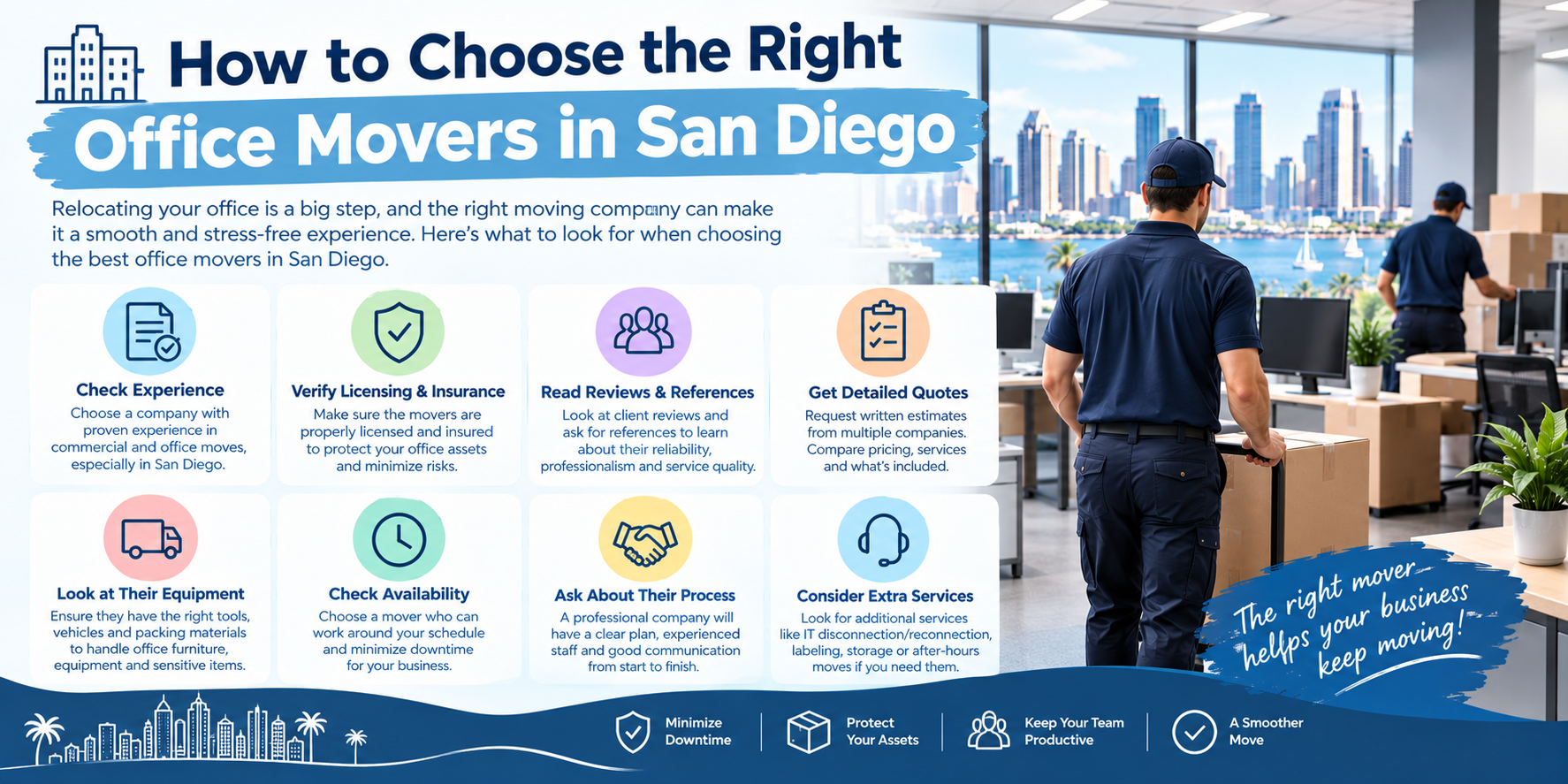
Relocating an office involves much more than transporting desks, chairs, and boxes from one building to another. Businesses must protect valuable equipment, organize documents, coordinate employees, and minimize disruptions to daily operations. Without proper planning, even a move to a nearby office in San Diego can become stressful and time-consuming.
Choosing the right office movers in San Diego can make the process easier to manage. Professional movers can help with packing, loading, transportation, furniture handling, and unloading, depending on the services your business needs. The right team will also understand the importance of communication, scheduling, and protecting workplace assets throughout the relocation.
Whether you are moving a small office, a growing company, or an entire corporate workspace, knowing what to look for in a moving company can help you make a more informed decision.
1. Look for Experience in Commercial Moving
Not every moving company has the same experience. Some primarily handle residential relocations, while others offer services specifically designed for offices and commercial spaces. Before choosing a company, ask about its experience with business relocations similar to yours.
Office moves often involve multiple workstations, conference room furniture, computers, printers, filing cabinets, and other business equipment. Larger relocations may also require coordination between departments and building management.
An experienced office moving company in San Diego should be prepared to discuss your requirements, identify potential challenges, and explain how it plans to manage the move. Ask whether the company has handled moves involving a similar office size, equipment type, or building layout.
This conversation can help you understand whether the movers are equipped to handle your business’s specific needs.
2. Verify Licensing and Insurance
Before hiring office movers, confirm that the company has the appropriate licensing and insurance for the services and type of move you need. This is particularly important when valuable equipment, furniture, and business property will be transported.
Ask the company to explain what protection is available for your belongings and what conditions, exclusions, or limitations apply. Do not assume that every item is automatically covered for its full replacement value.
You should also ask how the company handles damaged or missing items and what documentation is required if a problem occurs.
Taking time to verify these details before moving day can help your business avoid misunderstandings and make the relocation process more predictable.
3. Compare Written Moving Estimates
Office moving costs can vary depending on the size of the workspace, the volume of items, the distance between locations, the number of movers required, and the services included.
Request a written estimate that clearly explains the expected cost and scope of work. If possible, provide an accurate inventory and arrange an assessment of the office before accepting a quote.
When comparing estimates from commercial movers in San Diego, look beyond the final price. Check whether the quote includes packing materials, furniture disassembly, loading, transportation, unloading, and any requested storage services.
Ask about possible additional charges for special handling, access restrictions, long carrying distances, or changes to the moving schedule.
A lower quote may not represent the best value if important services are excluded. Comparing detailed estimates helps you understand what each company is offering and make a decision based on your budget and operational needs.
4. Ask About Packing and Equipment Protection
Office furniture and business equipment need appropriate handling during a move. Computers, monitors, printers, office chairs, desks, and conference room furniture can be damaged if they are packed or transported incorrectly.
Ask potential movers how they protect furniture and fragile equipment. Find out whether they provide packing supplies, protective wrapping, labeled boxes, and specialized handling when necessary.
Your internal team should also prepare computers and other electronic devices according to your IT department’s instructions. Back up important data, record equipment details, and arrange for authorized staff to disconnect and reconnect systems where required.
Confidential documents and sensitive information deserve additional attention. Keep important records organized and restrict access to them during the move. If your company handles confidential client information, establish a clear process for transporting and securing those materials.
The right moving plan should address both the physical safety of your belongings and the privacy of your business information.
5. Choose Movers Who Help Minimize Business Downtime
One of the biggest concerns during an office relocation is the potential interruption to business operations. Employees may be unable to work normally while equipment is being packed, transported, or installed at the new location.
When comparing office movers in San Diego, ask how they plan to coordinate the move around your business schedule.
Depending on availability and the scope of the project, you may be able to arrange the relocation outside regular business hours or divide it into stages. For example, departments that are less time-sensitive could move before teams responsible for customer service or essential operations.
Prepare a schedule that identifies when workstations will be packed, when equipment will be transported, and when the new office should be ready for use.
Also, communicate the schedule to employees and customers when necessary. A clear plan can help reduce confusion and give your team a better understanding of what to expect.
6. Confirm That the Moving Company Can Handle Your Office Size
A small office relocation may require only a few movers and a limited amount of equipment. A larger workspace may involve numerous desks, meeting rooms, storage areas, electronic devices, and shared facilities.
Before booking, explain the size and layout of your current office and the destination. Provide information about the number of workstations, large furniture items, elevators, staircases, loading areas, and any building access restrictions.
Ask the moving company whether it can provide the appropriate crew, transportation, and equipment for your relocation.
If your office contains unusually large machinery, specialized equipment, or oversized furniture, discuss these items in advance rather than assuming they can be handled as part of a standard move.
Accurate information allows the moving company to plan more effectively and helps reduce the risk of avoidable delays on moving day.
7. Check Reviews and Business Reputation
Online reviews can help you understand how a moving company communicates with customers and manages its services. However, it is important to evaluate feedback carefully rather than relying on an overall rating alone.
Look for comments that mention punctuality, communication, careful handling, accurate estimates, and the company’s response to problems. Reviews related to commercial moves may be especially useful when assessing a company for an office relocation.
You can also ask the company for references from previous business clients, where available.
Pay attention to how the company answers questions before you book. A professional provider should be willing to explain its services, discuss your concerns, and clarify the terms of the agreement.
Good communication before moving day is an important part of building confidence in your choice.
8. Understand the Moving Contract
Before confirming your booking, read the moving agreement carefully. It should clearly describe the services being provided, the expected schedule, the pricing arrangement, and the responsibilities of both parties.
Check the details of the pickup and delivery locations, the planned moving date, and any additional services you have requested. Confirm how changes to the schedule will be handled and whether there are cancellation or rescheduling conditions.
You should also review the company’s policies for claims, valuation coverage, and any limitations related to certain items.
If your building requires a certificate of insurance, elevator reservation, loading dock booking, or advance notice for commercial movers, confirm these requirements with the building manager and your moving company.
Having the important details in writing helps prevent confusion and gives everyone a clear reference throughout the relocation.
9. Ask About Furniture Disassembly and Reassembly
Many offices contain modular desks, cubicles, conference tables, shelving units, and other furniture that may need to be disassembled before transportation.
Not every moving quote automatically includes these services. Ask whether the movers can handle the furniture involved in your relocation and whether disassembly or reassembly carries an additional charge.
Prepare an inventory of items that need special attention. Label components and keep related hardware organized wherever practical. For complex workstations, photographs of the existing setup may help your team understand how everything should be arranged at the destination.
If your office uses specialized installations or equipment connected to electrical, network, or other building systems, arrange for qualified personnel to disconnect and reinstall those components.
Discussing these requirements in advance can make the setup process at your new office more organized.
10. Consider Storage and Flexible Moving Options
Sometimes a business cannot move everything directly into its new location. Renovations, delayed access, lease dates, or an incomplete workspace can create a gap between moving out and moving in.
If this applies to your business, ask whether the moving company offers storage options and how stored items are managed. Confirm the storage terms, access arrangements, fees, and protection available for your belongings.
You may also want to ask whether the company can support a phased relocation. Moving certain departments or equipment at different times can be useful when a business needs to maintain some operations during the transition.
Choose an arrangement that fits your timeline rather than paying for services your business does not need. Clear communication about dates, access, and storage requirements can help keep the relocation on track.
11. Prepare a Plan Before Moving Day
Even the right office movers need accurate information and coordination from your business. Preparing in advance helps the crew work efficiently and allows employees to understand their responsibilities.
Use the following checklist to get started:
- Confirm the moving date and schedule with the moving company.
- Notify employees about packing instructions and deadlines.
- Create an inventory of furniture, equipment, and important items.
- Label boxes and identify the department or destination for each one.
- Back up business data and coordinate IT equipment preparation.
- Separate confidential documents and items that require special handling.
- Confirm access, parking, elevator reservations, and loading arrangements at both locations.
- Identify items that need disassembly, special packing, or storage.
- Keep essential documents, keys, and critical business materials accessible to authorized staff.
- Inspect the new office before moving items into the space.
Assigning one employee or manager to coordinate with the movers can also help. This person can answer questions, communicate changes, and make sure important decisions are not delayed.
12. Choose a Moving Company That Communicates Clearly
Communication is an important factor when selecting a commercial moving company in San Diego. Office relocations involve several moving parts, and unclear instructions can lead to delays or misplaced items.
During the planning process, pay attention to how promptly the company responds and whether it provides straightforward answers. You should understand who your main contact will be, how updates will be shared, and what to do if the schedule changes.
A reliable moving partner should explain the process, discuss practical limitations, and help you identify requirements that need attention before moving day.
Avoid making a decision based only on promises of speed or the lowest price. Look for a company that understands your priorities and is willing to plan the move around your actual business requirements.
Why Consider US Eagle Moving for Office Relocation in San Diego?
Choosing a moving company that offers commercial relocation services can simplify the process of transferring your business to a new location.
US Eagle Moving provides office moving services in San Diego, with options for commercial relocation, packing, furniture handling, transportation, and storage where needed. Businesses can discuss their moving requirements with the team to determine which services are suitable for their office and schedule.
Before booking, share details about your current and new locations, the size of your office, the equipment that needs to be moved, and any access or scheduling restrictions. This information can help the team understand the scope of the relocation and prepare an appropriate estimate.
To discuss your office move, visit US Eagle Moving’s Office Movers San Diego page.
Conclusion
Choosing the right office movers in San Diego starts with understanding your business needs and comparing companies carefully. Commercial moving experience, transparent pricing, appropriate protection, clear communication, and a well-organized schedule can all contribute to a more manageable relocation.
Before booking, prepare an inventory, confirm building requirements, coordinate with employees, and discuss any specialized equipment or storage needs with your moving company. These steps can help reduce avoidable delays and make it easier to settle into your new workspace.
If your business is planning an office relocation, contact US Eagle Moving to discuss your requirements and request a moving estimate. Call at (858) 752-5051 to get started.
Frequently Asked Questions
How do I choose the best office movers in San Diego?
Compare commercial moving experience, licensing, insurance, written estimates, packing services, customer feedback, and communication. Choose a company that understands your office’s requirements and provides a clear plan for handling the relocation.
How far in advance should I book office movers?
Book as early as practical, especially if your business has a large office, a fixed relocation deadline, or building access restrictions. Early planning gives you more time to compare estimates, arrange building access, and prepare employees. Confirm availability directly with your preferred moving company.
What affects the cost of an office move in San Diego?
The cost may depend on office size, the volume of furniture and equipment, travel distance, packing requirements, labor, access conditions, furniture disassembly, and storage. Request a written estimate based on your actual moving requirements.
Can office movers help reduce business downtime?
Professional movers can help organize the schedule, transport equipment, and coordinate loading and unloading. Moving outside normal business hours or in planned stages may also help, depending on availability and your company’s operational needs.
Should I pack office equipment myself or hire professional packers?
The choice depends on your budget, the type of equipment, and your company’s internal procedures. Professional packing may be useful for fragile items and large quantities of office furniture. Your IT team should manage data backups and follow appropriate procedures for disconnecting and preparing electronic equipment.
What should I ask office movers before signing a contract?
Ask about the services included, pricing, scheduling, insurance or valuation coverage, handling of fragile equipment, additional charges, cancellation terms, and the process for reporting damage or missing items. Make sure the agreed services and important terms are documented in writing.